

In Person – Tuesday 30 September 2025, Bangkok, Thailand
Bangkok Climate Action Week is catalyzing whole-of-society action to accelerate the green transition in Southeast Asia.
This panel examines global transition gaps and solutions, focusing on actionable frameworks for the Global South, especially Southeast Asian countries. It assesses progress under the UNFCCC Just Transition Work Programme (JTWP), explores both OECD and emerging economies’ possible contribution to just transition challenges and explores finance models to meet just transition demands. It addresses the need for measurable indicators and inclusive governance.
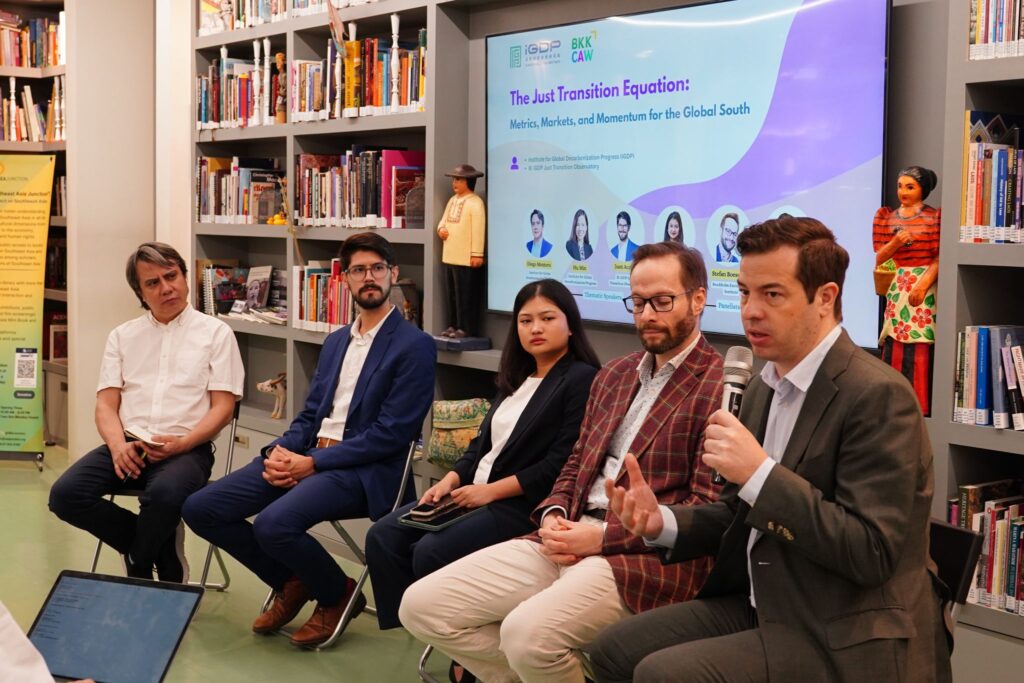
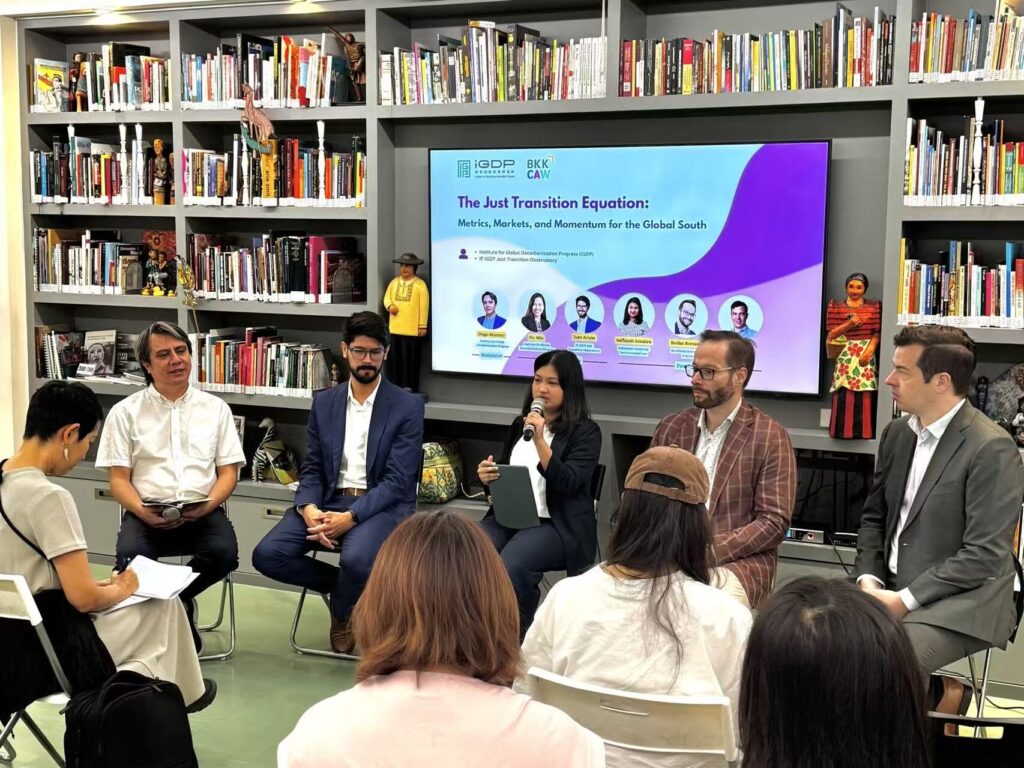
How do we make the energy transition just for the Global South? At Bangkok Climate Action Week (BKKCAW), we gathered at the heart of this question, bringing together civil society leaders and policy analysts to find answers. A huge thank you to our partner, the IE-iGDP Just Transition Observatory, our brilliant speakers, our moderator Diego Montero, and SEA Junction for providing the perfect space for a vibrant discussion.
Event key takeaways:
The Measurement Gap: HU Min from Institute for Global Decarbonization Progress highlighted that existing just transition indicator frameworks often miss critical priorities central to a just transition in Southeast Asia. Based on this, iGDP is developing a new indicator framework designed specifically for the Global South. It focuses on seven priorities: climate goals, economy-wide green transition, decent jobs, SDGs, poverty alleviation, social welfare, and climate finance access.
The Implementation Gap: Juan Daniel Acuña Román from the IE-iGDP Just Transition Observatory (JTO) outlined the challenge of moving from high-level concepts to ground-level action. JTO is developing two tools: an indicator framework to assess regions’ vulnerabilities and readiness for transition, and a guideline to help coal regions design and implement just transition strategies.

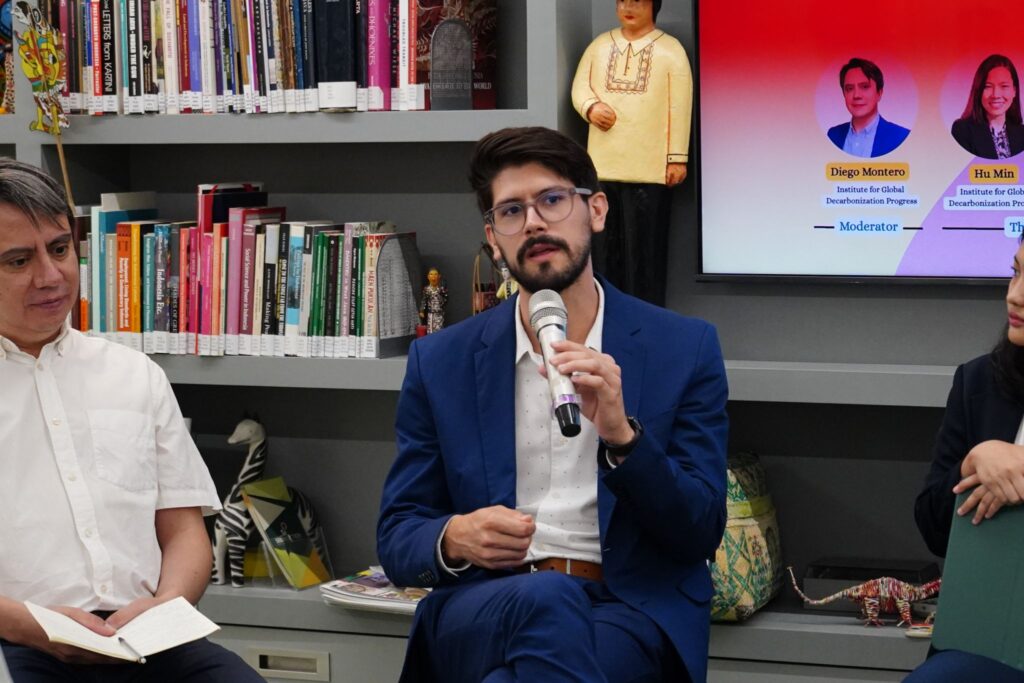
Diverse Perspectives from the Frontlines:
🔹Saffanah Rezky Azzahra Andrian (Indonesian Center for Environmental Law) underscored the vital role of civil society in complex financing mechanisms like Indonesia’s – amplifying marginalized voices, demanding transparency around complex loan-based financing, and tirelessly monitoring implementation.
🔹Stefan Bößner (Boessner) (SEI Asia – Stockholm Environment Institute) shared his research results on ASEAN and China, showing that while justice concepts are entering policy, implementation remains weak- none scored above 50% of the maximum score. Major gaps were found in areas such as labor justice and land rights.
🔹Huw Slater (ClientEarth) introduced the connection between just transition and carbon credits, detailing a pioneering project between Singapore and the Philippines that puts just transition principles directly into the financial flows for early closure of coal assets.
When asked for the one key to shaping the future, our panelists offered powerful levers: move from promises to production, establish formal policy frameworks, reallocate fossil fuel subsidies, and tie finance to verifiable outcomes.


We use both our own and third-party cookies to enhance our services and to offer you the content that most suits your preferences by analysing your browsing habits. Your continued use of the site means that you accept these cookies. You may change your settings and obtain more information here. Accept